


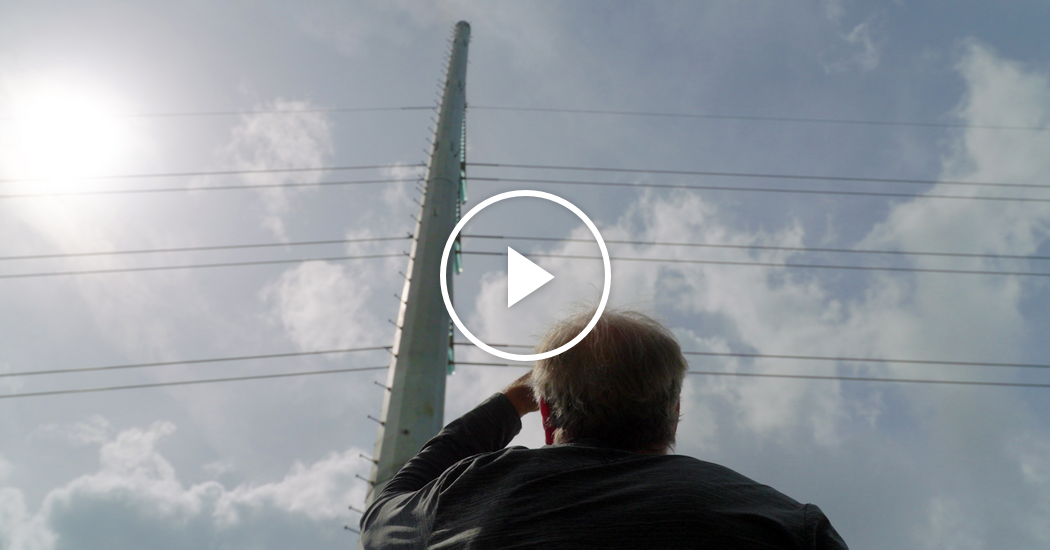
This is Doug Fergus, and this is his backyard. Last year, this high-voltage power line next to him took out a quarter of it. “We found this place that we love. And then within a year, we’re told it’s going to be changed totally. And we just felt like a punch in the gut.” A.I. data centers are coming to Georgia, and they need a lot of electricity. New power lines are going up to feed them, sometimes in people’s backyards, whether they like it or not. Nearly 400 trees were cut down to make way for this power line on Doug’s property. “It was solid trees like that all the way up to here. And now we have this unobstructed view of this new monstrosity.” The state’s biggest utility company, Georgia Power, says it offers fair compensation to homeowners when it needs to build infrastructure on their properties. But many residents say the offers they’ve receive don’t cover the property value they will lose from having a power line built in their backyard. “How’s it going?” “Good, how about you?” It’s Wednesday night. Two dozen local residents are meeting at a church to discuss another high-voltage transmission line that will soon cut through their backyards. “We chose the properties that we live on because of the quality that the property offered us. It is not about dirt and grass. It is about the whole property.” Some of them would move, but they say offers Georgia Power has made aren’t enough to start over again somewhere else. “What if in a year or two from now, they going to come and start another line? Because all those data centers — how do we know?” “To me personally, I need replacement value. I don’t want a penny over my — I want my dream here to have my dream here.” The statewide power line expansion will deliver about 10 gigawatts of new energy, enough to power twice the number of homes currently in the state of Georgia. Eighty percent of it will go to data centers. “We have seen a lot of growth come in the state. Much of it is data centers. And it’s not only the hyperscalers and the data centers, it’s the manufacturers, it’s industrial, it’s commercial. It’s also residential.” To meet that demand, many more transmission lines are needed. In 2019, Georgia Power’s 10-year plan called for 24 miles of new power lines. Last year, that number ballooned to 1,065 miles. “This infrastructure is actually benefiting all the surrounding communities. It will make anything through a storm and day-to-day more resilient, more reliable because of these large load users coming to our state.” “There’s a lot of pressure to bring this new energy online very quickly because states are currently competing for the opportunity to attract these data centers, even though the financial benefits of them for the state has not actually yet borne fruit.” “I feel like we can’t really plan for the future. We don’t know where we’re going to live in a year.” Rachael Maszk’s family bought their home four years ago. “We definitely bought this house for the backyard. We just knew there was going to be enough room for chickens, for a garden, for fruit trees.” Now, Georgia Power wants to use half of Rachael’s backyard for a transmission line and is offering her $57,000. “It’s a lot of money to us. It would be a lot of money to, I think, any regular person. But it isn’t enough money to cover the damage to our property value that this will cause.” During their negotiations over compensation, Rachael said representatives from the company discussed using eminent domain to take her land. Eminent domain gives utility companies power to seize private property for public use without the owner’s consent, if they pay fair compensation determined by the courts. “Eminent domain is always a last resort for our company. In fact, we use it less than 1 percent of the time.” “It feels like the only option is to reach a settlement with them, and I don’t really see what leverage the average person has in that situation.” “Before the poles went in, it was such a wonderful country, laid-back feel, rolling green grass landscape. And now it’s like we’re like inside an electric transfer station. Doesn’t feel like home anymore.” Doug reached a settlement with Georgia Power after more than a year of negotiating. He used that compensation to pay down half of his mortgage, but is reconsidering where to live out his retirement. “There’s really no amount of money that could erase all this and make it go back the way it was.”