


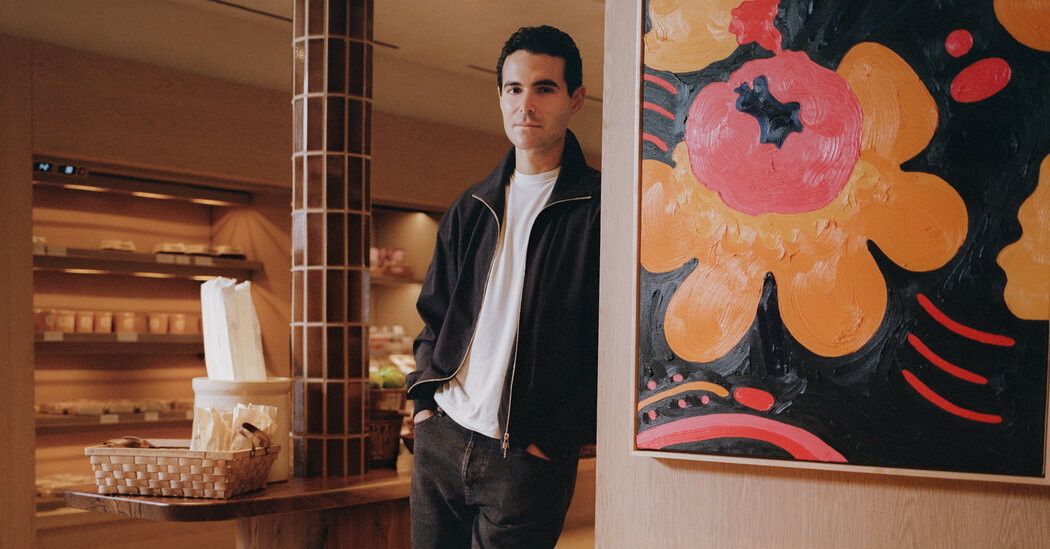
On a rainy March morning, 25 folding chairs were set out on the floor of Meadow Lane, a gourmet market in Lower Manhattan that is normally brimming with influencers, Tribeca moms and finance bros picking up lunch. Today the place belonged to McKinsey & Company.
The consultants are the ones who had requested the meeting. They wanted to know just how Meadow Lane had become such a thriving business in such a short time. They shook out their umbrellas and found their seats among the artisanal crackers, sea-moss beverages and carefully arranged jars of honey.
Sammy Nussdorf, the store’s 29-year-old owner, watched them settle in. Then he began to talk.
He told the consultants about the long permit purgatory he had endured before opening for business. He told them about the $65 olive oil and the $12 chicken salad. He told them about the kitchen’s struggles to keep up with demand. He even told them about the undercooked chicken nuggets that, much to his horror, became international news. By the time he was done, the consultants had questions.
Why stock Mexican Coke?
Nussdorf said he wanted an eclectic mix, rather than the usual health mart monoculture.
How did he select the brands for his shelves?
He had spent a year taste-testing products before opening, he said. And he made space for new products by not charging emerging indie brands a so-called slotting fee, unlike so many other retailers.
Did social media help?
Oh, yes. In fact, he considered his TikTok followers to be something like partners in the enterprise.
Satisfied, the consultants filled bags with products and snacks before thanking him for his time and heading back into the rain.
On the morning of the confab, Meadow Lane had been open 90 days. In that time, Nussdorf said, the store had served 80,000 customers while generating $3 million in revenue. On a given day, he said, more than 1,000 people passed through the 2,000-square-foot space on Greenwich Street.
“Operating a business like this in a place like New York is a nightmare,” he said. “I wouldn’t recommend it to anyone. But it’s so good.”
A Child of Wealth
He grew up on the Upper East Side, right across Fifth Avenue from the Metropolitan Museum of Art. He is the youngest son of Glenn Nussdorf, the chief executive of a family business, Quality King Distributors, a multibillion-dollar distributor of health and beauty products and prescription drugs.
Forbes has ranked the Nussdorfs among the 150 richest families in America. Sammy’s father, who keeps a low public profile, has asked to be removed from the listing.
“My family and I, we never talked about money,” Sammy said. “We’ve never discussed inheritance, assets, values, anything. I have no idea. I can guesstimate, if I wanted to, but I don’t really care.”
Nussdorf was cutting stems and arranging flowers (Japanese sweet peas and allium) in the studio off the main floor of Meadow Lane as he spoke of finding his way. He struggled academically during his years at Columbia Grammar and Prep, a private school on the Upper West Side. By his own account, he was a party kid, staying out in the clubs till 5 a.m. on school nights when he was 14.
He started a food Instagram in high school, documenting the Bolognese sauce and aglio e olio he made from scratch. As a sociology major at New York University, he hosted dinner parties in his first apartment.
Three blocks from where he lived, his father had a family investment office, Spring St. Group, and Sammy started working there in the summers. By the time he graduated in 2019, he was well versed in venture capital. Soon enough he assumed leadership duties.
“Nepotism awarded me the privilege to be in that position,” he said. “But the money that opened Meadow Lane is money I made in V.C.” He took a pause. “A lot of people didn’t believe it.”
While toiling in finance, he got serious about a hobby — floral arrangements. He would wake at 5 a.m. to source flowers at the markets along West 28th Street and deliver them to friends. He was drifting back to a version of himself crowded out by spreadsheets. He started envisioning a flower-and-coffee shop. He would call it Meadow Lane, after the five-mile strip in Southampton widely known as Billionaires Row, where the Nussdorf family has a home.
He scored a job with Jeff Leatham, a Los Angeles florist whose client list reads like a seating chart at the Met Gala. Friends from the East Coast would FaceTime Nussdorf to find him in a basement snipping stems. Away from the orchids and peonies, he found himself in the aisles of Erewhon, a high-end organic grocery store that was fast becoming an influencers’ hangout.
Ready to act on his plan, he returned to New York. But he quickly realized his original notion of a store devoted to flowers and coffee wasn’t going to cut it. There would have to be prepared foods, Peruvian grapes, matcha powder.
After signing a lease, he commissioned marketing agency proposals, only to find that the pros offered “really boring things for $15,000 a month,” he said. So he started a TikTok account.
The first thing he needed was a catchy handle. “Something really cringe,” he said. He decided on Brokeback Contessa, a melding of “Brokeback Mountain” and Ina Garten’s “Barefoot Contessa.” In an early video, Nussdorf explained that he was going to build a grocery store and document the process, start to finish, warts and all.
He showed himself having a tense meeting with a contractor and then riding an elevator, sunglasses on. A woman asks him to describe the meeting in three words. “Unhinged, disappointing and expensive,” he says. A TikTok star, or at least a viable social-media character, was born.
What happened next was either a master class in modern marketing or the kind of thing that happens when someone with lots of passion and no filter builds something in public. As Nussdorf posted videos detailing his setbacks and moments of doubt, the number of his TikTok followers swelled to more than 150,000.
“I think the more disclosure, the more unveiling of the curtain behind a private business, the more interested people are,” he said.
As Meadow Lane neared its opening date last November, thousands of people were invested in whether the New York City Department of Buildings would approve its gas line. Vogue and Vanity Fair sent reporters and photographers. Soon fans were stopping Nussdorf on the street: Hey, Brokeback! When are we getting the turkey pinwheels?
Bobby Flay’s Pep Talk
While building his business, Nussdorf has been managing an addiction.
“I was launching Meadow Lane in and out of rehab,” he said. “That had nothing to do with the delays. It was tough. After work, I would go home and lose control. No sleep. Just trying to fit in my addiction. Trying to hide it, too. It’s a nightmare.”
He said he knew his use of ketamine had gotten out of control. “I was sick of living that way, beholden to a substance that perpetuated isolation and deep sadness,” he said. “My addiction severed me from myself, everyone and everything I love. The journey forward is not easy. It’s a daily decision and practice.”
Meadow Lane helped him through it.
“When you’re in early recovery, you need purpose,” he said. “You need passion. You need a reason to wake up in the morning. It’s great therapy for me, whether I’m behind the table making flowers, which is my meditative state, or I’m helping customers.”
“In a way, I feel like this saved me,” he added. “Meadow Lane and my dog, Schnitzel.” (Schnitzel, for the record, is a mini goldendoodle).
TikTok-driven lines greeted the store’s opening. The kitchen, built for 300 transactions a day, was overwhelmed. At the same time, an online backlash targeted him for selling such high-priced goods. “People are threatening to burn down the store and throw rocks through the windows,” Nussdorf told The New York Post, which had made him a running character.
On day three, videos pinged across social media showing the undercooked chicken nuggets. Nussdorf was certain the mistake would sink him. He tracked down the affected customers and refunded them privately, he said, and he posted a video in which he took responsibility.
“The next day,” he said, “I didn’t think people were coming back — but the lines were longer.”
In the midst of the opening week drama, the celebrity chef Bobby Flay, a neighborhood resident, checked out the store. “He probably had the biggest pre-press in the history of opening a food business,” Flay said in an interview. “We were all paying attention to it.” He approached the owner, who seemed a bit down.
“This is so hard,” Nussdorf told him, Flay recalled.
Flay told him what every restaurateur eventually learns: “You asked for this and you got it. Now comes the practical part. Keep your head down and put out the best food you can every day.”
The pep talk worked.
“He talked me off the cliff,” Nussdorf said. “My entire team was telling me the same thing. But I couldn’t listen to them, because they weren’t Bobby Flay.”
The chaos of the early days is now behind him. Meadow Lane is an oasis of honey-toned wood and mellow lighting. The artichokes and radicchio heads look like components of a gallery installation.
The store’s logic reveals itself slowly, if at all. Heinz ketchup sits near Flamingo Estate olive oil. Duke’s mayonnaise is a few feet from Ballerina Farms protein powder.
“In the beginning, people were upset that we sold Duke’s,” Nussdorf said. “I’m like, it’s just the best mayonnaise! Just because something is on every shelf in America doesn’t mean it’s a bad product.”
He feels the criticism he has received for the prices isn’t warranted, adding that the average prepared meal costs about $22. “My Chipotle order of double protein is more than that,” he said. “Why is everyone so mad at me?”
Frances Truesdale, Nussdorf’s head of operations (and the daughter of Mary Margaret Truesdale, who runs hospitality for Ralph Lauren), has stuck with Nussdorf through the chicken nugget incident and the rehab stints. “We’ve seen it all together,” she said.
She has also seen a business owner who goes by instinct. “Brands, marketing — all of it has gotten so advanced,” Truesdale said. “There’s such exhaustion from that. He missteps. He says the wrong thing. He posts the wrong thing. And I think that, in an age where it’s easier than ever to appear perfect, Sammy is evolving beyond that.”
Asked what he saw himself doing at 50, Nussdorf said he had no idea. More Meadow Lane locations? Maybe. Maybe not. “I should probably make more friends,” he said. “I don’t do much outside of working.”
He clipped another stem and placed the flower in the vase. He held up the finished arrangement for Truesdale to see.
“I love it, Sammy,” she said.
“Yeah,” he said. “I’ve got to do flowers more often.”