


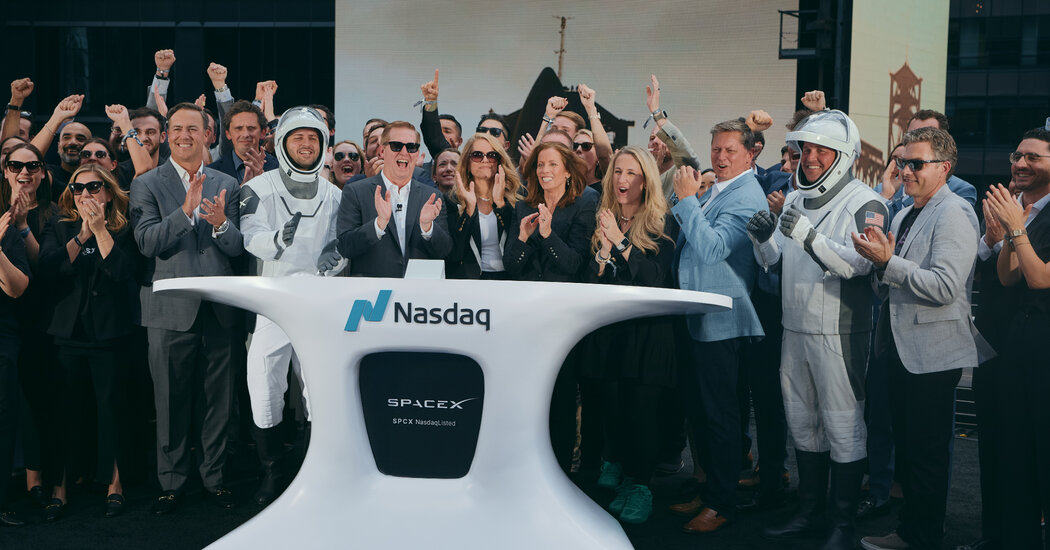
SpaceX’s share price continued to surge on Monday, the company’s first full day of trading, adding to its sharp move higher on Friday after its record-breaking public listing.
Elon Musk’s rocket maker and artificial intelligence company rose more than 15 percent in early afternoon trading on Monday. In a frenzied few hours of trading on Friday, the day of the company’s market debut, SpaceX rose nearly 20 percent.
The company announced on Monday that it ultimately had raised $85.7 billion in its initial public offering, after bankers exercised an option to buy more shares from the company at the I.P.O. price. That was significantly more than the $74.4 billion the company initially raised last week, which had already set the record for the largest I.P.O. ever.
SpaceX’s public market debut crowned Mr. Musk, 54, as the world’s first trillionaire and quelled jitters on Wall Street about whether investors would accept the company’s lofty valuation. The I.P.O. has come to be seen as a bellwether for other giant technology companies, namely Anthropic and OpenAI, seeking to go public this year.
After its latest gains, SpaceX was worth more than $2.4 trillion in market value. Anthropic and OpenAI, which have developed foundational A.I. models and chatbots, are each expected to go public with valuations approaching $1 trillion.
SpaceX’s giant I.P.O. topped the previous record set by Saudi Aramco, Saudi Arabia’s state-owned oil company, that raised more than $29 billion when it went public in 2019.
Mr. Musk and SpaceX redefined the space industry with partly reusable rockets and a satellite internet service, Starlink. In February, SpaceX bought Mr. Musk’s A.I. company, xAI, which also owned the social media platform, X, in a sweeping move to consolidate his business empire. By merging the companies, Mr. Musk provided a financial lifeline to xAI, which has spent billions of dollars trying to catch up with its rivals.
SpaceX, which has contracts with NASA and other federal agencies, had long been something of a financial mystery and functioned, at times, as a kind of piggy bank for Mr. Musk since 2002, when the company was founded.
But last month, the company revealed a full picture of its finances for the first time in preparation of the market debut. It reported that it had lost more than $4.9 billion last year, compared with a $791 million profit in 2024, because of increased expenditures on A.I. Revenue was $18.7 billion last year, up 33 percent from the previous year.
On Sunday, Mr. Musk said a series of social media posts that he believed that the rocket company could reach $1 trillion in revenue by 2030, far outstripping the already optimistic predictions by some of the company’s bankers. The trillionaire, who has a history of missing targets he sets for his companies, offered no explanation for his projections.
“And I would be surprised if revenue is not greater than $1T in 2031,” Mr. Musk wrote on X, the social platform owned by SpaceX.
The surge in SpaceX’s share price on Monday should also be seen in the context of global markets rallying in reaction to the preliminary deal to end the war in Iran, said Matt Kennedy, a senior strategist at Renaissance Capital.
He said he expected SpaceX to be a volatile stock this year, adding that it might trade below its I.P.O. price at some point. There is little scope for slip-ups, he noted, with the stock “priced to near perfection.”
Joe Rennison contributed reporting.